


Page 18 - Demo
P. 18
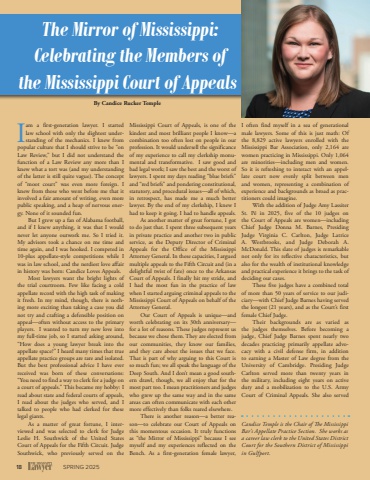
The Mirror of Mississippi:Celebrating the Members ofthe Mississippi Court of AppealsBy Candice Rucker TempleCandice Temple is the Chair of The MississippiBar's Appellate Practice Section. She works asa career law clerk to the United States DistrictCourt for the Southern District of Mississippiin Gulfport.Iam a first-generation lawyer. I startedlaw school with only the slightest understanding of the mechanics. I knew frompopular culture that I should strive to be %u201conLaw Review,%u201d but I did not understand thefunction of a Law Review any more than Iknew what a tort was (and my understandingof the latter is still quite vague). The conceptof %u201cmoot court%u201d was even more foreign. Iknew from those who went before me that itinvolved a fair amount of writing, even morepublic speaking, and a heap of nervous energy. None of it sounded fun.But I grew up a fan of Alabama football,and if I knew anything, it was that I wouldnever let anyone outwork me. So I tried it.My advisors took a chance on me time andtime again, and I was hooked. I competed in10-plus appellate-style competitions while Iwas in law school, and the nerdiest love affairin history was born: Candice Loves Appeals.Most lawyers want the bright lights ofthe trial courtroom. Few like facing a coldappellate record with the high task of makingit fresh. In my mind, though, there is nothing more exciting than taking a case you didnot try and crafting a defensible position onappeal%u2014often without access to the primaryplayers. I wanted to turn my new love intomy full-time job, so I started asking around,%u201cHow does a young lawyer break into theappellate space?%u201d I heard many times that trueappellate practice groups are rare and isolated.But the best professional advice I have everreceived was born of these conversations:%u201cYou need to find a way to clerk for a judge ona court of appeals.%u201d This became my hobby: Iread about state and federal courts of appeals,I read about the judges who served, and Italked to people who had clerked for theselegal giants.As a matter of great fortune, I interviewed and was selected to clerk for JudgeLeslie H. Southwick of the United StatesCourt of Appeals for the Fifth Circuit. JudgeSouthwick, who previously served on theMississippi Court of Appeals, is one of thekindest and most brilliant people I know%u2014acombination too often lost on people in ourprofession. It would undersell the significanceof my experience to call my clerkship monumental and transformative. I saw good andbad legal work; I saw the best and the worst oflawyers. I spent my days reading %u201cblue briefs%u201dand %u201cred briefs%u201d and pondering constitutional,statutory, and procedural issues%u2014all of which,in retrospect, has made me a much betterlawyer. By the end of my clerkship, I knew Ihad to keep it going. I had to handle appeals.As another matter of great fortune, I gotto do just that. I spent three subsequent yearsin private practice and another two in publicservice, as the Deputy Director of CriminalAppeals for the Office of the MississippiAttorney General. In these capacities, I arguedmultiple appeals to the Fifth Circuit and (in adelightful twist of fate) once to the ArkansasCourt of Appeals. I finally hit my stride, andI had the most fun in the practice of lawwhen I started arguing criminal appeals to theMississippi Court of Appeals on behalf of theAttorney General.Our Court of Appeals is unique%u2014andworth celebrating on its 30th anniversary%u2014for a lot of reasons. These judges represent usbecause we chose them. They are elected fromour communities, they know our families,and they care about the issues that we face.That is part of why arguing to this Court isso much fun; we all speak the language of theDeep South. And I don%u2019t mean a good southern drawl, though, we all enjoy that for themost part too. I mean practitioners and judgeswho grew up the same way and in the sameareas can often communicate with each othermore effectively than folks reared elsewhere.There is another reason%u2014a better reason%u2014to celebrate our Court of Appeals onthis momentous occasion. It truly functionsas %u201cthe Mirror of Mississippi%u201d because I seemyself and my experiences reflected on theBench. As a first-generation female lawyer,I often find myself in a sea of generationalmale lawyers. Some of this is just math: Ofthe 8,829 active lawyers enrolled with theMississippi Bar Association, only 2,164 arewomen practicing in Mississippi. Only 1,064are minorities%u2014including men and women.So it is refreshing to interact with an appellate court now evenly split between menand women, representing a combination ofexperience and backgrounds as broad as practitioners could imagine.With the addition of Judge Amy LassiterSt. P%u00e9 in 2025, five of the 10 judges onthe Court of Appeals are women%u2014includingChief Judge Donna M. Barnes, PresidingJudge Virginia C. Carlton, Judge LatriceA. Westbrooks, and Judge Deborah A.McDonald. This slate of judges is remarkablenot only for its reflective characteristics, butalso for the wealth of institutional knowledgeand practical experience it brings to the task ofdeciding our cases.These five judges have a combined totalof more than 50 years of service to our judiciary%u2014with Chief Judge Barnes having servedthe longest (21 years), and as the Court%u2019s firstfemale Chief Judge.Their backgrounds are as varied asthe judges themselves. Before becoming ajudge, Chief Judge Barnes spent nearly twodecades practicing primarily appellate advocacy with a civil defense firm, in additionto earning a Master of Law degree from theUniversity of Cambridge. Presiding JudgeCarlton served more than twenty years inthe military, including eight years on activeduty and a mobilization to the U.S. ArmyCourt of Criminal Appeals. She also served18 SPRING 2025


