


Page 14 - Demo
P. 14
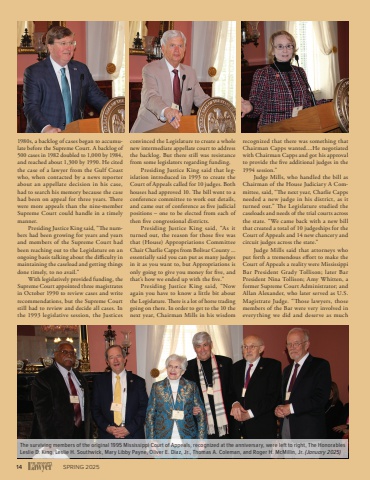
1980s, a backlog of cases began to accumulate before the Supreme Court. A backlog of500 cases in 1982 doubled to 1,000 by 1984,and reached about 1,300 by 1990. He citedthe case of a lawyer from the Gulf Coastwho, when contacted by a news reporterabout an appellate decision in his case,had to search his memory because the casehad been on appeal for three years. Therewere more appeals than the nine-memberSupreme Court could handle in a timelymanner.Presiding Justice King said, %u201cThe numbers had been growing for years and yearsand members of the Supreme Court hadbeen reaching out to the Legislature on anongoing basis talking about the difficulty inmaintaining the caseload and getting thingsdone timely, to no avail.%u201dWith legislatively provided funding, theSupreme Court appointed three magistratesin October 1990 to review cases and writerecommendations, but the Supreme Courtstill had to review and decide all cases. Inthe 1993 legislative session, the Justicesconvinced the Legislature to create a wholenew intermediate appellate court to addressthe backlog. But there still was resistancefrom some legislators regarding funding.Presiding Justice King said that legislation introduced in 1993 to create theCourt of Appeals called for 10 judges. Bothhouses had approved 10. The bill went to aconference committee to work out details,and came out of conference as five judicialpositions %u2013 one to be elected from each ofthen five congressional districts.Presiding Justice King said, %u201cAs itturned out, the reason for those five wasthat (House) Appropriations CommitteeChair Charlie Capps from Bolivar County ...essentially said you can put as many judgesin it as you want to, but Appropriations isonly going to give you money for five, andthat%u2019s how we ended up with the five.%u201dPresiding Justice King said, %u201cNowagain you have to know a little bit aboutthe Legislature. There is a lot of horse tradinggoing on there. In order to get to the 10 thenext year, Chairman Mills in his wisdomrecognized that there was something thatChairman Capps wanted....He negotiatedwith Chairman Capps and got his approvalto provide the five additional judges in the1994 session.%u201dJudge Mills, who handled the bill asChairman of the House Judiciary A Committee, said, %u201cThe next year, Charlie Cappsneeded a new judge in his district, as itturned out.%u201d The Legislature studied thecaseloads and needs of the trial courts acrossthe state. %u201cWe came back with a new billthat created a total of 10 judgeships for theCourt of Appeals and 14 new chancery andcircuit judges across the state.%u201dJudge Mills said that attorneys whoput forth a tremendous effort to make theCourt of Appeals a reality were MississippiBar President Grady Tollison; later BarPresident Nina Tollison; Amy Whitten, aformer Supreme Court Administrator; andAllan Alexander, who later served as U.S.Magistrate Judge. %u201cThose lawyers, thosemembers of the Bar were very involved ineverything we did and deserve as muchThe surviving members of the original 1995 Mississippi Court of Appeals, recognized at the anniversary, were left to right, The HonorablesLeslie D. King, Leslie H. Southwick, Mary Libby Payne, Oliver E. Diaz, Jr., Thomas A. Coleman, and Roger H. McMillin, Jr. (January 2025)14 SPRING 2025


