


Page 10 - Demo
P. 10
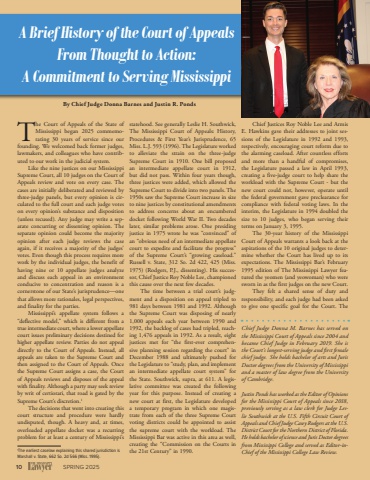
A Brief History of the Court of AppealsFrom Thought to Action:A Commitment to Serving MississippiBy Chief Judge Donna Barnes and Justin R. PondsChief Judge Donna M. Barnes has served onthe Mississippi Court of Appeals since 2004 andbecame Chief Judge in February 2019. She isthe Court%u2019s longest-serving judge and first femalechief judge. She holds bachelor of arts and JurisDoctor degrees from the University of Mississippiand a master of law degree from the Universityof Cambridge.Justin Ponds has worked as the Editor of Opinionsfor the Mississippi Court of Appeals since 2018,previously serving as a law clerk for Judge Leslie Southwick at the U.S. Fifth Circuit Court ofAppeals and Chief Judge Casey Rodgers at the U.S.District Court for the Northern District of Florida.He holds bachelor of science and Juris Doctor degreesfrom Mississippi College and served as Editor-inChief of the Mississippi College Law Review.The Court of Appeals of the State ofMississippi began 2025 commemorating 30 years of service since ourfounding. We welcomed back former judges,lawmakers, and colleagues who have contributed to our work in the judicial system.Like the nine justices on our MississippiSupreme Court, all 10 judges on the Court ofAppeals review and vote on every case. Thecases are initially deliberated and reviewed bythree-judge panels, but every opinion is circulated to the full court and each judge voteson every opinion%u2019s substance and disposition(unless recused). Any judge may write a separate concurring or dissenting opinion. Theseparate opinion could become the majorityopinion after each judge reviews the caseagain, if it receives a majority of the judges%u2019votes. Even though this process requires morework by the individual judges, the benefit ofhaving nine or 10 appellate judges analyzeand discuss each appeal in an environmentconducive to concentration and reason is acornerstone of our State%u2019s jurisprudence%u2014onethat allows more rationales, legal perspectives,and finality for the parties.Mississippi%u2019s appellate system follows a%u201cdeflective model,%u201d which is different from atrue intermediate court, where a lower appellatecourt issues preliminary decisions destined forhigher appellate review. Parties do not appealdirectly to the Court of Appeals. Instead, allappeals are taken to the Supreme Court andthen assigned to the Court of Appeals. Oncethe Supreme Court assigns a case, the Courtof Appeals reviews and disposes of the appealwith finality. Although a party may seek reviewby writ of certiorari, that road is gated by theSupreme Court%u2019s discretion.1The decisions that went into creating thiscourt structure and procedure were hardlyundisputed, though. A heavy and, at times,overloaded appellate docket was a recurringproblem for at least a century of Mississippi%u2019s1The earliest caselaw explaining this shared jurisdiction isMarshall v. State, 662 So. 2d 566 (Miss. 1995).statehood. See generally Leslie H. Southwick,The Mississippi Court of Appeals: History,Procedures & First Year%u2019s Jurisprudence, 65Miss. L.J. 593 (1996). The Legislature workedto alleviate the strain on the three-judgeSupreme Court in 1910. One bill proposedan intermediate appellate court in 1912,but did not pass. Within four years though,three justices were added, which allowed theSupreme Court to divide into two panels. The1950s saw the Supreme Court increase in sizeto nine justices by constitutional amendmentsto address concerns about an encumbereddocket following World War II. Two decadeslater, similar problems arose. One presidingjustice in 1975 wrote he was %u201cconvinced%u201d ofan %u201cobvious need of an intermediate appellatecourt to expedite and facilitate the progress%u201dof the Supreme Court%u2019s %u201cgrowing caseload.%u201dRussell v. State, 312 So. 2d 422, 425 (Miss.1975) (Rodgers, P.J., dissenting). His successor, Chief Justice Roy Noble Lee, championedthis cause over the next few decades.The time between a trial court%u2019s judgment and a disposition on appeal tripled to981 days between 1981 and 1992. Althoughthe Supreme Court was disposing of nearly1,000 appeals each year between 1990 and1992, the backlog of cases had tripled, reaching 1,476 appeals in 1992. As a result, eightjustices met for %u201cthe first-ever comprehensive planning session regarding the court%u201d inDecember 1988 and ultimately pushed forthe Legislature to %u201cstudy, plan, and implementan intermediate appellate court system%u201d forthe State. Southwick, supra, at 611. A legislative committee was created the followingyear for this purpose. Instead of creating anew court at first, the Legislature developeda temporary program in which one magistrate from each of the three Supreme Courtvoting districts could be appointed to assistthe supreme court with the workload. TheMississippi Bar was active in this area as well,creating the %u201cCommission on the Courts inthe 21st Century%u201d in 1990.Chief Justices Roy Noble Lee and ArmisE. Hawkins gave their addresses to joint sessions of the Legislature in 1992 and 1993,respectively, encouraging court reform due tothe alarming caseload. After countless effortsand more than a handful of compromises,the Legislature passed a law in April 1993,creating a five-judge court to help share theworkload with the Supreme Court - but thenew court could not, however, operate untilthe federal government gave preclearance forcompliance with federal voting laws. In theinterim, the Legislature in 1994 doubled thesize to 10 judges, who began serving theirterms on January 3, 1995.The 30-year history of the MississippiCourt of Appeals warrants a look back at theaspirations of the 10 original judges to determine whether the Court has lived up to itsexpectations. The Mississippi Bar%u2019s February1995 edition of The Mississippi Lawyer featured the yeomen (and yeowoman) who weresworn in as the first judges on the new Court.They felt a shared sense of duty andresponsibility, and each judge had been askedto give one specific goal for the Court. The10 SPRING 2025


