


Page 13 - Demo
P. 13
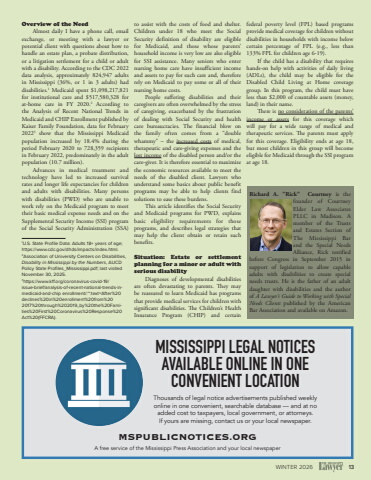
MISSISSIPPI LEGAL NOTICESAVAILABLE ONLINE IN ONECONVENIENT LOCATIONThousands of legal notice advertisements published weeklyonline in one convenient, searchable database %u2014 and at noadded cost to taxpayers, local government, or attorneys.If yours are missing, contact us or your local newspaper.MSPUBLICNOTICES.ORGA free service of the Mississippi Press Association and your local newspaperBar-MPA 12-05-25.indd 1 10/22/25 11:13%u202fAMOverview of the NeedAlmost daily I have a phone call, emailexchange, or meeting with a lawyer orpotential client with questions about how tohandle an estate plan, a probate distribution,or a litigation settlement for a child or adultwith a disability. According to the CDC 2022data analysis, approximately 824,947 adultsin Mississippi (36%, or 1 in 3 adults) haddisabilities.1 Medicaid spent $1,098,217,821for institutional care and $517,580,328 forat-home care in FY 2020.2 According tothe Analysis of Recent National Trends inMedicaid and CHIP Enrollment published byKaiser Family Foundation, data for February20223 show that the Mississippi Medicaidpopulation increased by 18.4% during theperiod February 2020 to 728,359 recipientsin February 2022, predominately in the adultpopulation (10.7 million).Advances in medical treatment andtechnology have led to increased survivalrates and longer life expectancies for childrenand adults with disabilities. Many personswith disabilities (PWD) who are unable towork rely on the Medicaid program to meettheir basic medical expense needs and on theSupplemental Security Income (SSI) programof the Social Security Administration (SSA)1U.S. State Profile Data: Adults 18+ years of age;https://www.cdc.gov/dhds/impacts/index.html.2Association of University Centers on Disabilities,Disability in Mississippi by the Numbers, AUCDPolicy State Profiles_Mississippi.pdf; last visitedNovember 30, 2025.3https://www.kff.org/coronavirus-covid-19/issue-brief/analysis-of-recent-national-trends-inmedicaid-and-chip enrollment/:~:text=After%20declines%20in%20enrollment%20from%202017%20through%202019,,by%20the%20Families%20First%20Coronavirus%20Response%20Act%20(FFCRA).to assist with the costs of food and shelter.Children under 18 who meet the SocialSecurity definition of disability are eligiblefor Medicaid, and those whose parents%u2019household income is very low are also eligiblefor SSI assistance. Many seniors who enternursing home care have insufficient incomeand assets to pay for such care and, thereforerely on Medicaid to pay some or all of theirnursing home costs.People suffering disabilities and theircaregivers are often overwhelmed by the stressof caregiving, exacerbated by the frustrationof dealing with Social Security and healthcare bureaucracies. The financial blow onthe family often comes from a %u201cdoublewhammy%u201d %u2013 the increased costs of medical,therapeutic and care-giving expenses and thelost income of the disabled person and/or thecare-giver. It is therefore essential to maximizethe economic resources available to meet theneeds of the disabled client. Lawyers whounderstand some basics about public benefitprograms may be able to help clients findsolutions to ease these burdens.This article identifies the Social Securityand Medicaid programs for PWD, explainsbasic eligibility requirements for thoseprograms, and describes legal strategies thatmay help the client obtain or retain suchbenefits.Situation: Estate or settlementplanning for a minor or adult withserious disabilityDiagnoses of developmental disabilitiesare often devastating to parents. They maybe reassured to learn Medicaid has programsthat provide medical services for children withsignificant disabilities. The Children%u2019s HealthInsurance Program (CHIP) and certainfederal poverty level (FPL) based programsprovide medical coverage for children withoutdisabilities in households with income belowcertain percentage of FPL (e.g., less than133% FPL for children age 6-19).If the child has a disability that requireshands-on help with activities of daily living(ADLs), the child may be eligible for theDisabled Child Living at Home coveragegroup. In this program, the child must haveless than $2,000 of countable assets (money,land) in their name.There is no consideration of the parents%u2019income or assets for this coverage whichwill pay for a wide range of medical andtherapeutic services. The parents must applyfor this coverage. Eligibility ends at age 18,but most children in this group will becomeeligible for Medicaid through the SSI programat age 18.Richard A. \Courtney is thefounder of CourtneyElder Law AssociatesPLLC in Madison. Amember of the Trustsand Estates Section ofThe Mississippi Barand the Special NeedsAlliance, Rick testifiedbefore Congress in September 2015 insupport of legislation to allow capableadults with disabilities to create specialneeds trusts. He is the father of an adultdaughter with disabilities and the authorof A Lawyer%u2019s Guide to Working with SpecialNeeds Clients published by the AmericanBar Association and available on Amazon.WINTER 2026 13


