


Page 8 - Demo
P. 8
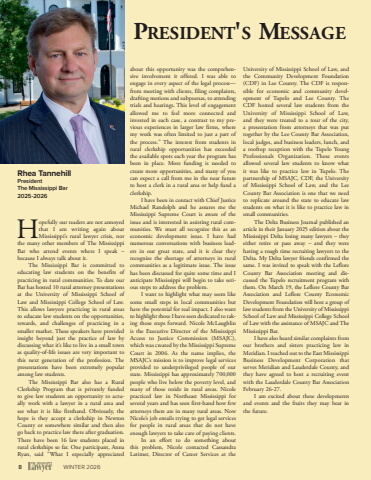
President's MessageRhea TannehillPresidentThe Mississippi Bar2025-2026Hopefully our readers are not annoyedthat I am writing again aboutMississippi%u2019s rural lawyer crisis, northe many other members of The MississippiBar who attend events where I speak %u2013because I always talk about it.The Mississippi Bar is committed toeducating law students on the benefits ofpracticing in rural communities. To date ourBar has hosted 10 rural attorney presentationsat the University of Mississippi School ofLaw and Mississippi College School of Law.This allows lawyers practicing in rural areasto educate law students on the opportunities,rewards, and challenges of practicing in asmaller market. These speakers have providedinsight beyond just the practice of law bydiscussing what it%u2019s like to live in a small townas quality-of-life issues are very important tothis next generation of the profession. Thepresentations have been extremely popularamong law students.The Mississippi Bar also has a RuralClerkship Program that is privately fundedto give law students an opportunity to actually work with a lawyer in a rural area andsee what it is like firsthand. Obviously, thehope is they accept a clerkship in NewtonCounty or somewhere similar and then alsogo back to practice law there after graduation.There have been 16 law students placed inrural clerkships so far. One participant, AnnaRyan, said \about this opportunity was the comprehensive involvement it offered. I was able toengage in every aspect of the legal process%u2014from meeting with clients, filing complaints,drafting motions and subpoenas, to attendingtrials and hearings. This level of engagementallowed me to feel more connected andinvested in each case, a contrast to my previous experiences in larger law firms, wheremy work was often limited to just a part ofthe process.\rural clerkship opportunities has exceededthe available spots each year the program hasbeen in place. More funding is needed tocreate more opportunities, and many of youcan expect a call from me in the near futureto host a clerk in a rural area or help fund aclerkship.I have been in contact with Chief JusticeMichael Randolph and he assures me theMississippi Supreme Court is aware of theissue and is interested in assisting rural communities. We must all recognize this as aneconomic development issue. I have hadnumerous conversations with business leaders in our great state, and it is clear theyrecognize the shortage of attorneys in ruralcommunities as a legitimate issue. The issuehas been discussed for quite some time and Ianticipate Mississippi will begin to take serious steps to address the problem.I want to highlight what may seem likesome small steps in local communities buthave the potential for real impact. I also wantto highlight those I have seen dedicated to taking those steps forward. Nicole McLaughlinis the Executive Director of the MississippiAccess to Justice Commission (MSAJC),which was created by the Mississippi SupremeCourt in 2006. As the name implies, theMSAJC%u2019s mission is to improve legal servicesprovided to underprivileged people of ourstate. Mississippi has approximately 700,000people who live below the poverty level, andmany of those reside in rural areas. Nicolepracticed law in Northeast Mississippi forseveral years and has seen first-hand how fewattorneys there are in many rural areas. NowNicole%u2019s job entails trying to get legal servicesfor people in rural areas that do not haveenough lawyers to take care of paying clients.In an effort to do something aboutthis problem, Nicole contacted CassandraLatimer, Director of Career Services at theUniversity of Mississippi School of Law, andthe Community Development Foundation(CDF) in Lee County. The CDF is responsible for economic and community development of Tupelo and Lee County. TheCDF hosted several law students from theUniversity of Mississippi School of Law,and they were treated to a tour of the city,a presentation from attorneys that was puttogether by the Lee County Bar Association,local judges, and business leaders, lunch, anda rooftop reception with the Tupelo YoungProfessionals Organization. These eventsallowed several law students to know whatit was like to practice law in Tupelo. Thepartnership of MSAJC, CDF, the Universityof Mississippi School of Law, and the LeeCounty Bar Association is one that we needto replicate around the state to educate lawstudents on what it is like to practice law insmall communities.The Delta Business Journal published anarticle in their January 2025 edition about theMississippi Delta losing many lawyers %u2013 theyeither retire or pass away %u2013 and they werehaving a tough time recruiting lawyers to theDelta. My Delta lawyer friends confirmed thesame. I was invited to speak with the LefloreCounty Bar Association meeting and discussed the Tupelo recruitment program withthem. On March 19, the Leflore County BarAssociation and Leflore County EconomicDevelopment Foundation will host a group oflaw students from the University of MississippiSchool of Law and Mississippi College Schoolof Law with the assistance of MSAJC and TheMississippi Bar.I have also heard similar complaints fromour brothers and sisters practicing law inMeridian. I reached out to the East MississippiBusiness Development Corporation thatserves Meridian and Lauderdale County, andthey have agreed to host a recruiting eventwith the Lauderdale County Bar AssociationFebruary 26-27.I am excited about these developmentsand events and the fruits they may bear inthe future.8 WINTER 2026


